Best Software for Acquiring Google Reviews: 2026 Buyer's Guide
Practical picks and workflows for agencies, local businesses, and franchises to win more Google reviews at scale.
How to Evaluate Software for Acquiring Google Reviews
Define goals and baseline metrics
Choosing the best software for acquiring Google reviews starts with clear goals tied to real business outcomes. Decide whether your priority is volume, star rating distribution, or conversion impact from profiles. Establish a baseline for current review count, response time, and average rating so you can measure lift. Map how reviews influence your local pack visibility and click-through rates across branded and non-branded searches. Align stakeholders on definitions of success and the timeline to achieve them.
Translate those goals into trackable metrics inside your analytics stack and your chosen Google review management tools. Standard KPIs include request-to-review conversion rate, reviews per location per month, and percentage of reviews with keywords. Consider customer journey touchpoints that create the right moment to ask for feedback. Segment benchmarks by location, service line, or agent to spot outliers early. Make sure leadership agrees on thresholds that trigger coaching or workflow changes.
Must-have capabilities in the best software for acquiring Google reviews
Review generation software should centralize requests, scheduling, and follow-up across SMS, email, and QR flows. Look for short-link generation that deep-links to the Google rating interface to remove friction. Prioritize template libraries, dynamic fields, and A/B testing so you can optimize copy by audience and moment. Ensure throttling and smart send windows to avoid spamming customers and tripping filters. Seek inbox consolidation that pulls in reviews and messages for faster, smarter responses.
Data and governance matter as much as outreach features in Google My Business review software. You need role-based access, location hierarchies, and audit logs for distributed teams. Native integrations with POS, CRM, helpdesk, and appointment systems reduce manual work and boost accuracy. API access and webhooks future-proof your stack as processes change. Finally, insist on clear consent capture, opt-out handling, and policy-safe workflows for long-term, risk-free scale.
Integration and data hygiene
Clean data is the backbone of reliable request automation and accurate attribution. Standardize contact fields, country codes, and consent flags before syncing to your review generation software. Validate that each location has the correct Google Business Profile URL, categories, and service areas. Build deduplication rules and bounce handling to protect sender reputation and reporting fidelity. Refresh data routinely so requests align with recent interactions, not stale contacts.
Integrations should reflect how your service is delivered and when satisfaction peaks. Connect ticket solved events, job completion milestones, or invoice paid triggers to request flows. Use customer feedback tools to capture private NPS or CSAT first, then route promoters to Google. Pass segments like product line, language, or agent to personalize messages at scale. Maintain a source-of-truth diagram so teams know where each field originates and how it's updated.
Top Features That Drive More Google Reviews
Seamless request flows and timing
Frictionless flows raise conversion, especially on mobile where most customers respond. SMS-first requests with a single, branded link consistently outperform email-only outreach. Follow with a polite reminder after 48-72 hours if there's no response, and cap total touches per customer. Include clear value language and a transparent ask so customers understand the impact of their review. Use localized sender IDs and time windows to keep messages relevant and respectful.
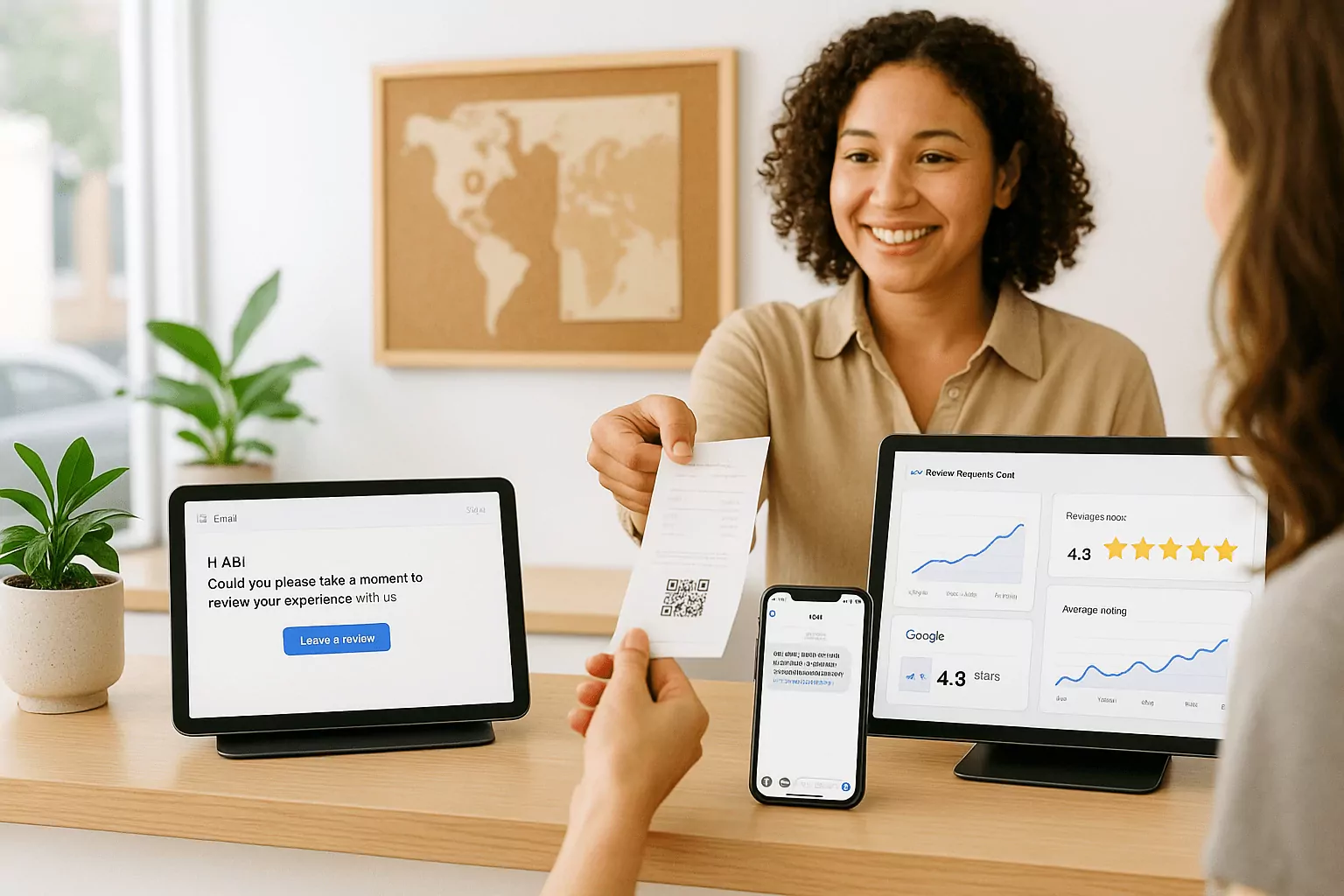
Flow logic should adapt to channel preferences and interaction type. For in-person visits, QR codes on receipts, counters, and packaging make participation effortless. For service calls, trigger an SMS when the technician closes the job and the experience is fresh. For ecommerce, send after delivery confirmation rather than at order placement. Test timing across segments and let your Google review management tools optimize sends automatically.
Smart segmentation and personalization
Segmentation turns generic asks into contextually relevant invitations. Separate first-time buyers from loyal customers and tailor tone accordingly. Reference the product, location, or service completed to jog memory and improve authenticity. Match language to customer preference and keep messages concise and personable. Avoid incentives that conflict with policy; gratitude and clarity outperform gimmicks long-term.
Dynamic content should be easy to manage inside your review generation software. Pull in agent names, appointment dates, and service types for precision. Swap templates based on NPS or CSAT so promoters get a public ask while detractors get service recovery. Use frequency caps across all channels to maintain goodwill and list health. Monitor performance by segment to uncover high-yield opportunities and refine outreach rules.
Review routing, filtering, and compliance
Policy-safe workflows are non-negotiable when scaling review volume. Avoid gating practices that only send public asks to satisfied customers, which violates platform rules. Instead, sequence private feedback first, then invite all customers to share their public opinion. Provide accessible opt-outs in every message and honor them system-wide. Keep a transparent audit trail of templates, send logic, and consent status.
Routing should ensure negative signals trigger rapid recovery, not suppression. Send low scores to a service queue with context and customer history. Escalate urgent cases and empower frontline staff to resolve issues quickly and authentically. Publish balanced, representative reviews to build long-term trust and better local rankings. Use online reputation management dashboards to visualize trends and coaching opportunities.
Best Software for Acquiring Google Reviews: Use-Case Picks
Local businesses and solo operators
Small teams need simplicity, automation, and fast setup over complex customization. Prioritize tools with intuitive templates, QR support, and SMS that works out of the box. Affordable pricing per location and streamlined onboarding reduce friction and pay back quickly. Native integrations with appointment apps and lightweight CRMs keep workflows lean. Clear reporting on reviews per week and request conversion keeps focus on growth.
For this audience, the best software for acquiring Google reviews emphasizes essential features, not bloat. A compact dashboard, mobile app support, and quick reply tools are critical. Google Business Profile link management must be effortless and reliable. Basic online reputation management views help track trends without overwhelming detail. Look for community support, quick-start playbooks, and live chat help when you're short on time.
Multi-location brands and franchises
Enterprises need hierarchy, permissions, and brand governance at scale. Choose platforms that mirror your org chart with regions, markets, and franchisees. Enforce brand-approved templates while allowing local personalization inside guardrails. Centralize analytics across locations for roll-up reporting and competitive benchmarking. Automate location onboarding and verification to keep profiles consistent and healthy.
Scalable review generation software must interoperate with CRM, CDP, and service systems. Role-based access and SSO streamline adoption across large teams. API-first architectures support custom triggers and advanced segmentation. Distributed response workflows reduce lag while maintaining quality and compliance. Measure lift by location and correlate with revenue, foot traffic, and call volume.
Agencies and resellers
Agencies prioritize multi-tenant control, packaging flexibility, and white-label delivery. Pick platforms with branded portals, custom domains, and invoice-friendly usage metrics. Templates and automations should clone across clients while allowing tweaks per niche. Cross-account dashboards save hours and surface wins for client reporting. Margin-friendly pricing and partner support underpin sustainable growth.
The best software for acquiring Google reviews for agencies must accelerate onboarding and retention. On-demand training, sales enablement collateral, and shared playbooks reduce ramp time. Audit tools for profiles and listings help win new business with clear gap analyses. Bulk actions and standardized setups create consistent outcomes across verticals. Embed online reputation management insights in regular client reviews to highlight ROI.
Implementation Playbook: Setup, Requests, and Follow-Up
Configure profiles, CTAs, and links
Start with a complete, accurate Google Business Profile for each location. Verify addresses, hours, categories, and services to improve visibility and trust. Generate direct review links and test them on multiple devices and browsers. Add consistent calls-to-action across receipts, emails, websites, and packaging. Train staff on when and how to ask, using simple, genuine language.
Build a micro landing page if your tool supports it, reducing steps and confusion. Display platform badges and privacy notes to reinforce credibility. Localize copy and fallback language for multilingual audiences. Keep QR codes prominent and scannable in physical spaces customers frequent. Review profiles monthly to catch changes, suspensions, or duplicate entries early.
Automate triggers and templates
Turn routine events into reliable review requests with smart triggers. Fire requests after job completion, appointment checkout, or delivery confirmation. Use staggered reminders with polite, human copy to maximize response while respecting inboxes. Create templates for major segments and personalize with dynamic fields. A/B test subject lines, SMS length, and link placement to refine performance.
Coordinate automation across channels to prevent overlap and fatigue. Centralize frequency caps and quiet hours within your Google review management tools. Sync bounce and unsubscribe data so suppression lists stay accurate. Log every send and outcome for compliance and optimization insights. Refresh templates quarterly to reflect seasonal offers, new services, and evolving tone.
Close the loop with customer feedback tools
Pair public review requests with private feedback collection to enhance service quality. Start with a short NPS or CSAT survey to learn before you ask to share. Route low scores to internal resolution while offering every customer the option to post publicly. Summarize learnings in weekly standups so teams act quickly on recurring themes. Track resolution speed and re-engagement rates to prove the value of recovery.
Customer feedback tools should tag themes automatically using NLP or predefined lists. Highlight issues that impact rating and retention, like wait times or staff interactions. Feed insights to training, staffing, and product teams for systemic fixes. Close the loop with a courteous follow-up once issues are resolved. Celebrate wins by sharing standout reviews in team channels and on site.
Measuring Impact and Staying Compliant
KPIs, dashboards, and ROI
Define a small, stable set of KPIs that tie to revenue and visibility. Track request volume, conversion, reviews per location, average rating, and response time. Attribute downstream effects like direction requests, calls, and site visits from profile analytics. Compare treated vs. control cohorts to isolate impact where possible. Build executive and frontline dashboards tailored to each audience's decisions.
ROI emerges from greater visibility, stronger social proof, and higher conversion. Quantify savings from automation compared to manual outreach. Estimate lifetime value lift from improved retention driven by feedback loops. Benchmark against competitors to understand share-of-voice gains in your category. Reinvest wins into more locations, segments, and experimentation.
Policy-safe practices in Google's ecosystem
Operate within Google's guidelines to protect your long-term presence. Don't offer incentives tied to positive sentiment or filter who you invite to review. Avoid bulk solicitation tactics that feel spammy or mislead customers. Respond to all reviews promptly and professionally, without sharing personal data. Keep leadership informed about policy updates and platform changes.
Compliance should be coded into templates and workflows, not just training slides. Use moderation only for prohibited content while keeping feedback transparent. Maintain clear records of consent and communication history. Standardize escalation paths for legal or sensitive issues. Review vendor roadmaps to ensure features keep pace with evolving rules.
Iteration and A/B testing
Continuous improvement compounds small wins into major gains. Test copy tone, send times, and channel order to find your best-performing mix. Iterate landing page design, link placement, and CTA phrasing for clarity. Trial different segmentation rules, like recent spend or service type, to unlock new pockets of volume. Archive learnings in a shared playbook to accelerate future campaigns.
Use your review generation software's reporting to drive weekly experiments. Set clear hypotheses, sample sizes, and success thresholds before launching. Rotate winning tests into default flows while queuing the next round. Share results with sales and service leaders to align incentives and messaging. Keep a steady cadence so improvements remain visible and motivated.
Frequently Asked Questions
What makes software truly the best for acquiring Google reviews?
The standout platforms balance automation, compliance, and ease of use. They orchestrate SMS, email, and QR flows with smart timing and frequency caps. Deep integrations with CRM and service tools trigger relevant, timely requests. Robust reporting connects review lift to traffic, calls, and revenue. Governance features like roles, hierarchies, and audit logs support teams at any scale. Most importantly, they encourage authentic, representative feedback that builds lasting trust.
How fast should I expect results after rollout?
Most teams see a measurable uptick in review volume within two to four weeks. Early gains come from automating requests at key moments and cleaning profile links. Stronger compounding effects arrive over two to three months as templates, timing, and segments are optimized. Response-time improvements and better service recovery accelerate rating stability. Seasonal dynamics and traffic volume still matter, so compare against historical baselines. Keep testing and refining weekly to sustain momentum.
Can I use incentives to get more Google reviews?
Direct incentives tied to positive sentiment risk violating platform policies and eroding credibility. Instead, focus on respectful, well-timed asks and clear value statements about helping local shoppers. Offer the same invitation to all customers, and never filter based on score. Use private feedback channels to resolve issues while allowing everyone to post publicly. Authenticity and consistency outperform gimmicks long-term in both ranking and conversion. Align staff rewards to process quality, not review sentiment.